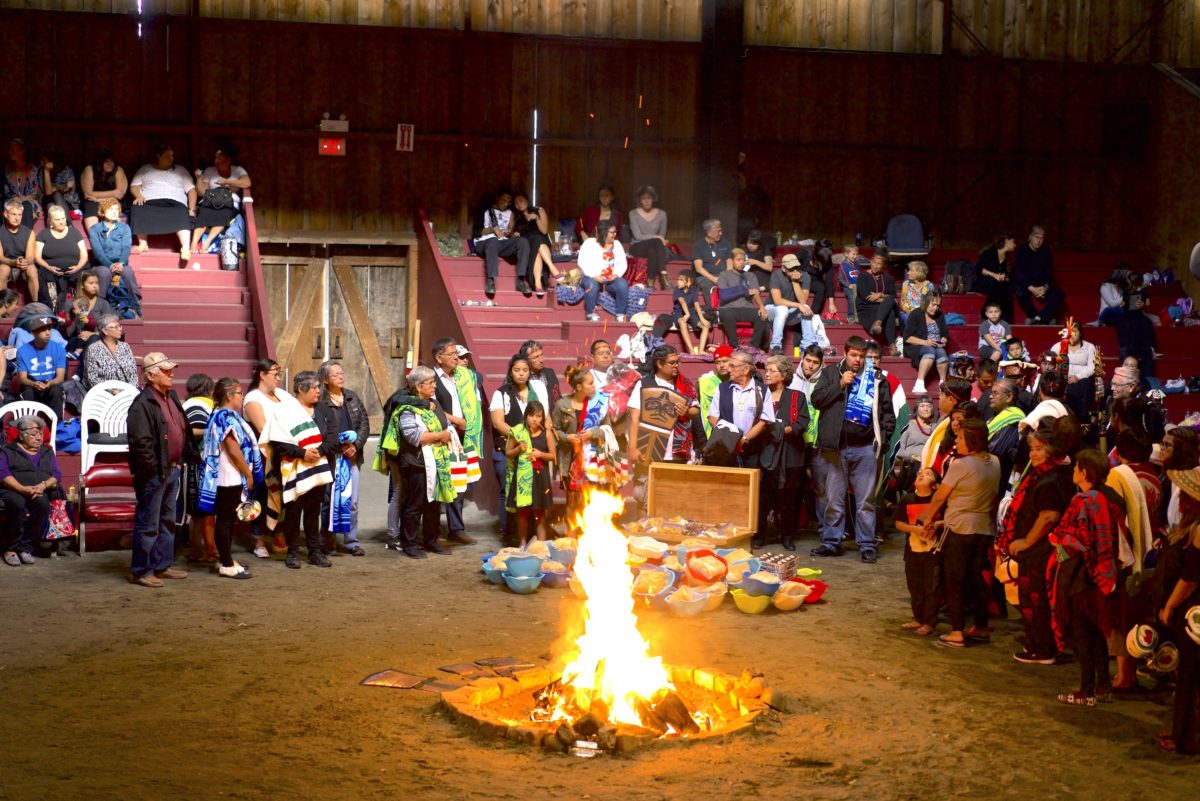
On the coast of the Pacific Northwest, chiefs once won status by giving wealth away.
In ceremonies known as potlatches, rivals competed to hand out – and sometimes destroy – their most valuable possessions. They burnt their canoes and gave out their coppers.1
The logic was simple.
Anybody can claim to be powerful. Only a genuinely powerful person can afford to set their own wealth alight without flinching.
These chiefs were performing what we now call costly signalling.
And I’d argue AI has just turned it into perhaps the most powerful influencing strategy in modern business.
Words are cheap, but visible cost creates trust
You’re probably bombarded by messages all day.
I'm talking pings via email, LinkedIn, your intranet, whatever instant messaging platform your company has opted for.
Many of these messages want you to do something. Perhaps buy a product or come to their event or follow a new system or fill out yet another internal survey.
Oh, and everybody is claiming their thing is either brilliant, important, or both 🙄
So who do you believe?
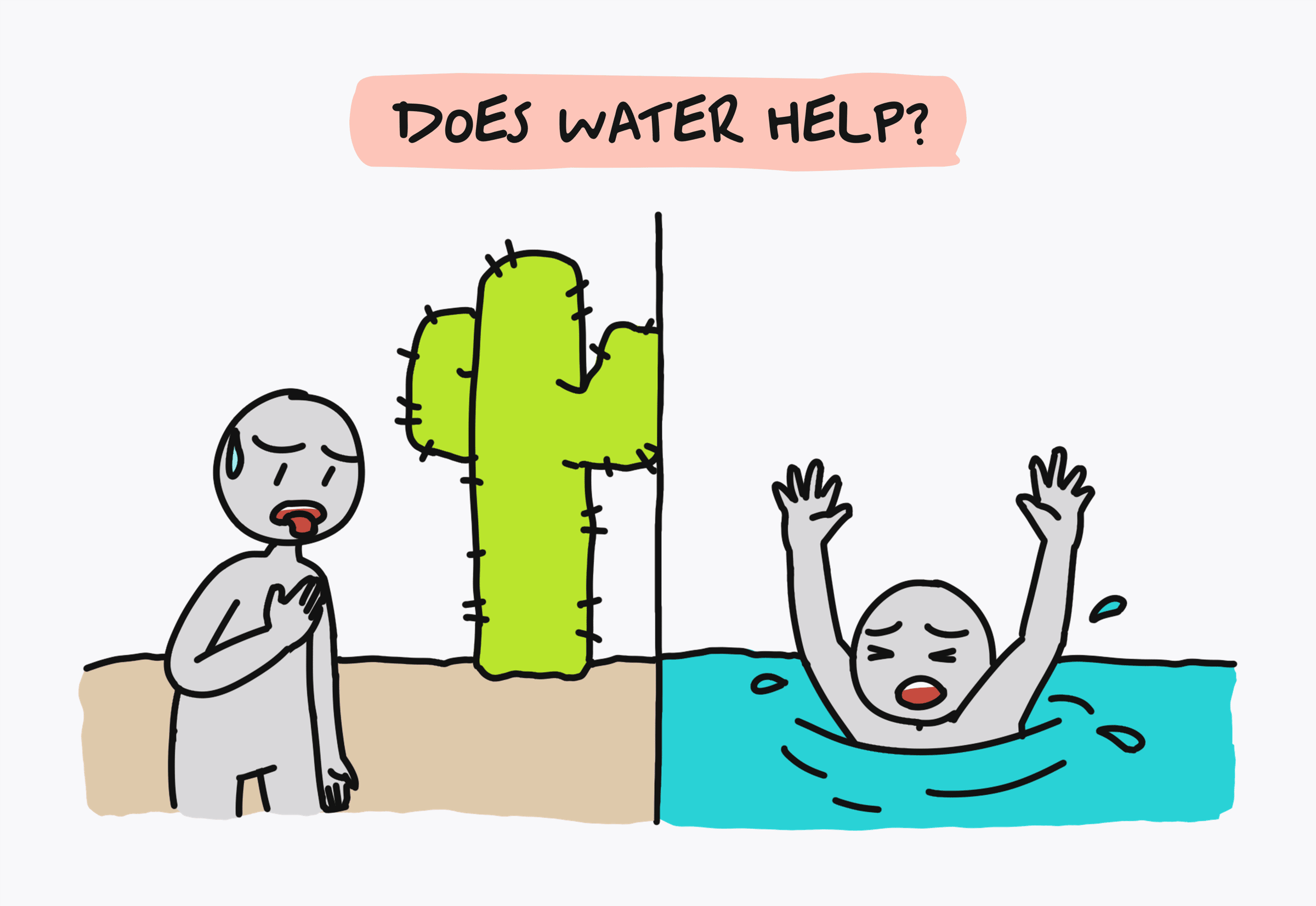
The problem is that anyone can make claims with little consequence. Anyone can say their product is brilliant, their intentions pure, their proposal the one you should back.
Some messages, though, come with a cost.
Imagine two leaders.
Both claim to ‘care about your wellbeing’.
But one day, life happens to you. Perhaps a diagnosis, a divorce, a poorly child, a parent who suddenly needs you.
The first leader says, "I'm so sorry to hear that. Let me know if I can help." And leaves it at that.
The second leader moves your deadlines, reassigns the client call, tells you to take the week, and sends a care package to your door.
Who are you more likely to believe?
I imagine it'd be the second leader.
And it's because they used costly signalling. Their message required time, effort, money, risk, or sacrifice to send, and this is precisely what made it more believable.
This instinct runs far deeper than this fictional example.
Biologists argue that across many species, costly signals are how animals prove strength, health or status, because the proof can't be bluffed.
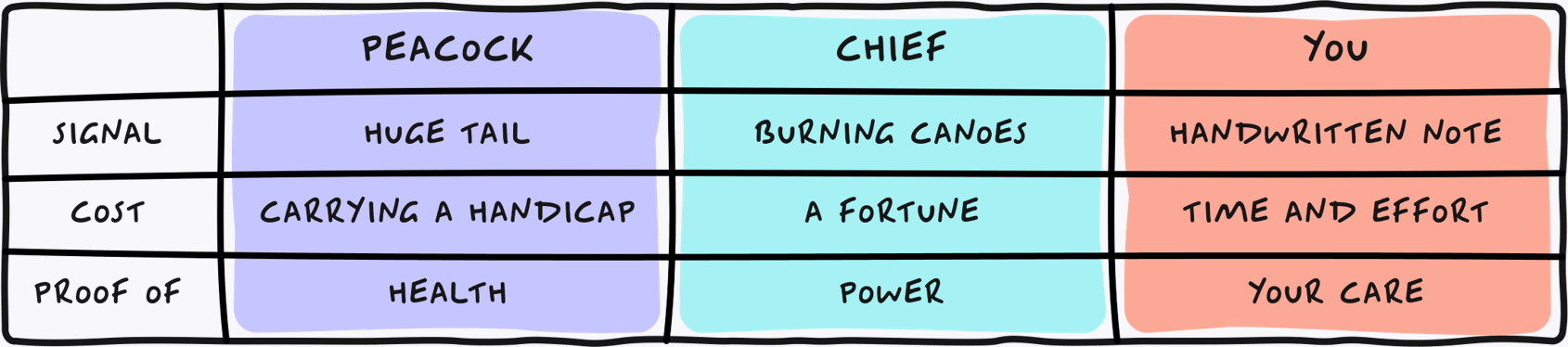
Perhaps most famously, the peacock's tail works as a signal of health precisely because a sickly bird couldn't sustain one.2
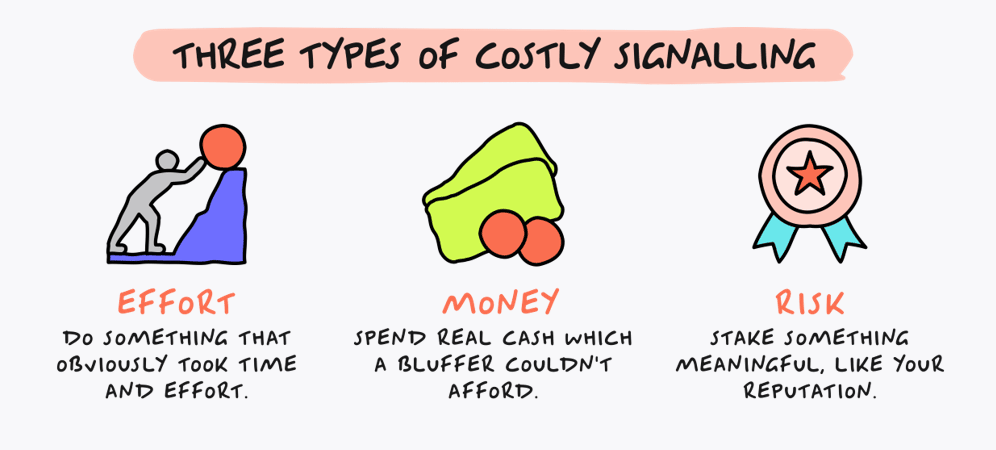
For humans, the cost typically comes in one of three forms:
1. Effort. Doing something that obviously took time and effort.
2. Money. Spend or sacrifice real cash a bluffer couldn't afford.
3. Risk. Staking something, like your reputation.
In short, in a world where claims cost nothing, visible cost is what turns communication into proof.
But AI has created a signalling arms race
Let me break down the term 'costly signalling', because the two words hide different processes.
Let's start with 'signalling'.
This is the way you communicate. At the ceremonies discussed earlier, it was burning the canoe. For peacocks, it's the huge tail.
Second, you have the 'costly' part.
This is what you gave up by communicating - the effort, the money, the risk. For chiefs, that was wealth and a perfectly serviceable canoe. For peacocks, it was potential survival.
Critically, AI has changed the cost of signals.
A few years ago, all of these required significant cost in time, effort, or risk:
· Personalised messages
· Polished pitch decks
· Sleek websites
Not today.
Now, in a matter of seconds, you can have beautiful prose, written by your LLM of choice. You use tools like Claude to write, Gamma to build slides, Lovable to build apps, ChatGPT to build imagery.
This creates both a problem and an opportunity.
The problem is that people are bombarded with more bland, frictionless communication than ever before, as everyone embraces AI to generate supposedly “personalised” messages at industrial scale.
These people are trying to benefit from costly signalling, without the actual cost.
But unfortunately for them, most people know how easily lots of these messages can be created by AI.
The opportunity though?
Costly signalling definitely still works.
And thankfully, when everyone is drowning in the same generic AI-generated sludge, it's perhaps never been easier to stand out.
We just need to think about which messages still requires cost in the age of AI.
What still can't be faked in a post AI world
Let's organise possible signals in three categories: what AI easily fakes, what it can somewhat fake, and what it still can't touch.
1. AI can easily fake
The following signals might have historically signalled great cost, but AI has suddenly made them pretty damn easy:
- Flawless, confident prose
- Basic slick decks, websites, apps, logos
- "Personalised" messages built from an online footprint
- Professional photography and imagery that never happened
2. AI can fake a little
These signals are still detectably imperfect or genuinely laborious to fake well:
- "Personal" videos because whilst avatars and voice clones exist, you can probably still tell the difference if you know the person.
- Handwritten notes, as robot-pen services can do this for you, but again they're imperfect.
- A consistent voice and stream of decent content over months.
3. AI still can't fake well
These signals still bring cost, as AI struggles to emulate them:
- Truly expert copywriting.
- High-end design and animation.
- Financial sacrifices to show you back an idea or person.
- Taking time out, such as by physically being present.
- Making personal sacrifices, such as giving credit away or killing your pet project for the benefit of the organisation.
If you want people to believe your message, I'd suggest reading through the second and third lists above.
Then ask yourself one uncomfortable question:
➝ What have I done that AI couldn't have done in a few seconds or minutes?
If the honest answer is "not much", don't be surprised when your ask gets ignored - or, at best, is met with a shrug of scepticism.
Make it cost you something, visibly.
It's perhaps the best way to make them believe you.
Thanks for reading,
Matt
P.S. Forward this on to a pal who needs to influence. They can get The Illogical Edge here.

Notes
[1] Mauss, M. (1990). The gift: The form and reason for exchange in archaic societies (W. D. Halls, Trans.). Routledge. (Original work published 1925)
[2] Zahavi, A. (1975). Mate selection—A selection for a handicap. Journal of Theoretical Biology, 53(1), 205–214. https://doi.org/10.1016/0022-5193(75)90111-3