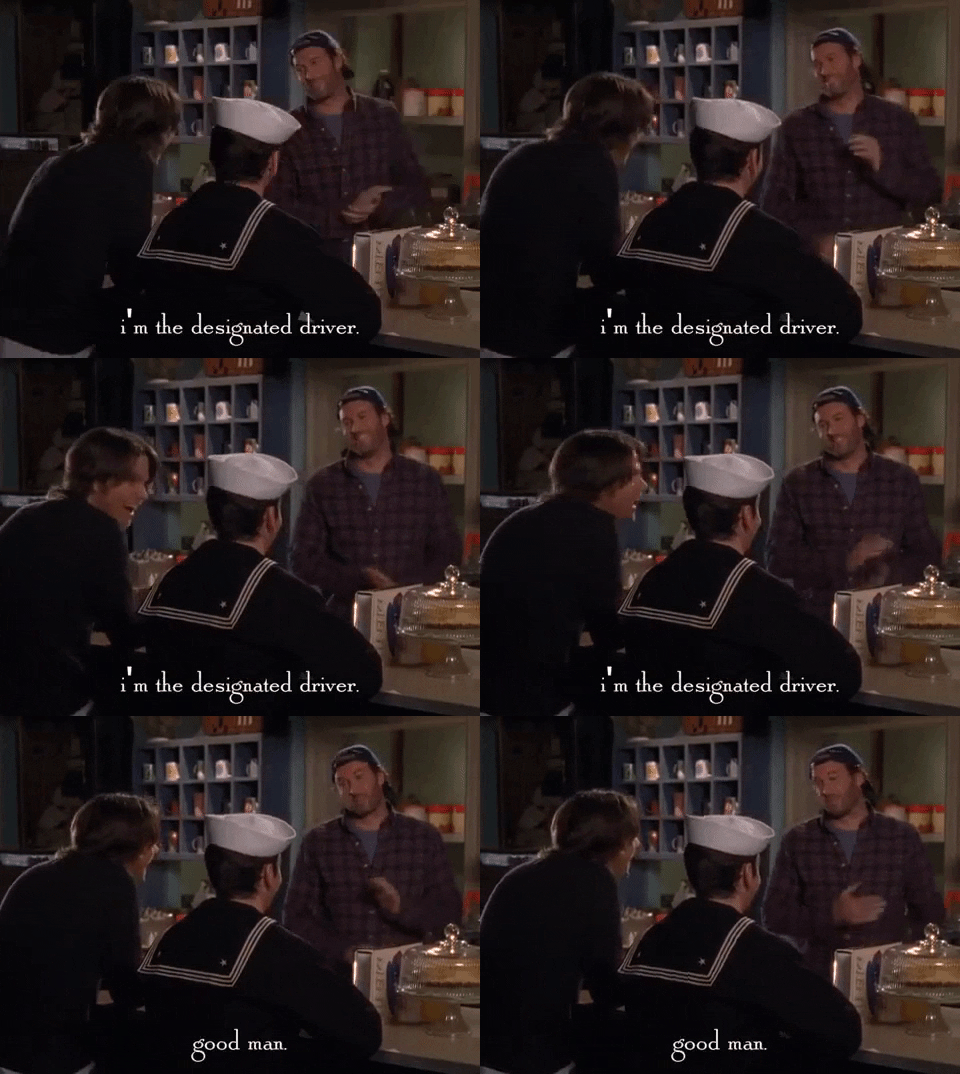
In 1988, a Harvard team set out to tackle American drink-driving – without adverts, warnings, or a single statistic about road deaths.
Instead, they persuaded Hollywood writers to slip two words into the scripts of more than 160 prime-time shows, including Cheers and L.A. Law.1
Those words captured a phrase taken from Scandinavian culture:
➝ 'Designated driver'
By 1991, this term was in the English dictionary.
And by 1994, alcohol-related road deaths had fallen 30%, and more than a third of Americans had served as a designated driver themselves. The change in language was deemed to have had a causal impact on behaviour.
You can apply this same strange behavioural science to influence too.
An introduction to charismatic language
I've come to call terms like this charismatic language.
Charismatic language is any intentionally crafted word or phrase, usually by marketers, campaigners, journalists, or authors, to popularise an idea or change what people do.
'Designated driver' is an example of charismatic language.
So are 'quiet quitting', 'AI slop', 'imposter syndrome', '10,000 steps', 'greenwashing', 'brain rot', 'mansplaining', 'doomscrolling', 'deep work', '80/20', 'glamping', and 'Brexit'.
I doubt somebody sat you down and taught you these terms. You heard them and they just stuck.
These terms typically do at least one of two things:
Job 1: Naming to make it a thing
Language decides what people can see, and what they can comfortably ask of one another.
"Who's the designated driver?" is an askable question, for instance.
"Who's agreeing to stay sober tonight so they can drive us all home?" never was.
The name created a role you could volunteer for, and a question any friend could ask without it being weird.
Many other terms work in the same way, turning an abstract concept into something that's easy to spot and understand.
Think about:
- Imposter syndrome
- Psychological safety
- Carbon footprint
- Radical candour
- Staycation
Some names go a step further as the verdict comes built into the language, like 'AI slop' or 'humblebrag' or 'brain rot'. You instantly know none of these things are positive.
Job 2: Naming to make it normal
Other terms don't stop at changing the way you see the world. Some also prescribe a new behaviour.
From what I can see, they do this in one of three ways:
- They hand you a role.
A designated driver, an early adopter, a digital nomad, or an influencer is an identity you can step into. Part of the Harvard campaign's genius was turning the person not drinking from the boring one into the heroic one. - They hand you a target.
'Be more active' has no finish line, whereas 10,000 steps is a precise goal. The same applies to five-a-day and the eight-hour sleep target. These have undoubtedly driven hundreds of people's personal benchmarks. - They hand you a date.
Dry January reminds people to stop drinking at the start of the year. Movember and Meat-free Monday use the same calendar trick.
So as all these examples show, just one or two words can have a strange, sticky influence on how people see the world and even how they act within it.
But at this point, you might be wondering if this has any practical use in your life.
I have good news for you.
You already name projects, meetings, rituals, models, frameworks, expectations, initiatives.
It's just that most of these names get wasted on some rubbish default or cliché like:
Meeting -> "Q3 Ops Review"
Process -> "Annual talent review"
Behaviour framework -> "We raise the bar"
Ugh.
Contrast that with the deliberate namers.
Amazon caps meeting sizes with its two-pizza rule. Engineers dissect failures in blameless post-mortems. Google famously carved out 20% time, and plenty of firms now protect focus with no-meeting Wednesdays.
And this isn't just for big businesses.
A few years back, I was working with a Sales Director who found his team unreceptive to his asks to stay in touch with their networks as a source of potential leads.
He launched his five-a-day idea - an encouragement to send five cold messages to old contacts every day.
It stuck.
His team would talk, even when he wasn't in the room, about how they were getting on with their five-a-day.
Clearly, this is not some high and mighty strategy unavailable to you or me.

The four types of charismatic language
Some terms, like 'quiet quitting', circled the world in a month. But 'work to rule' - the same idea with a 60 year head start - is barely known.
So what makes some language stick?
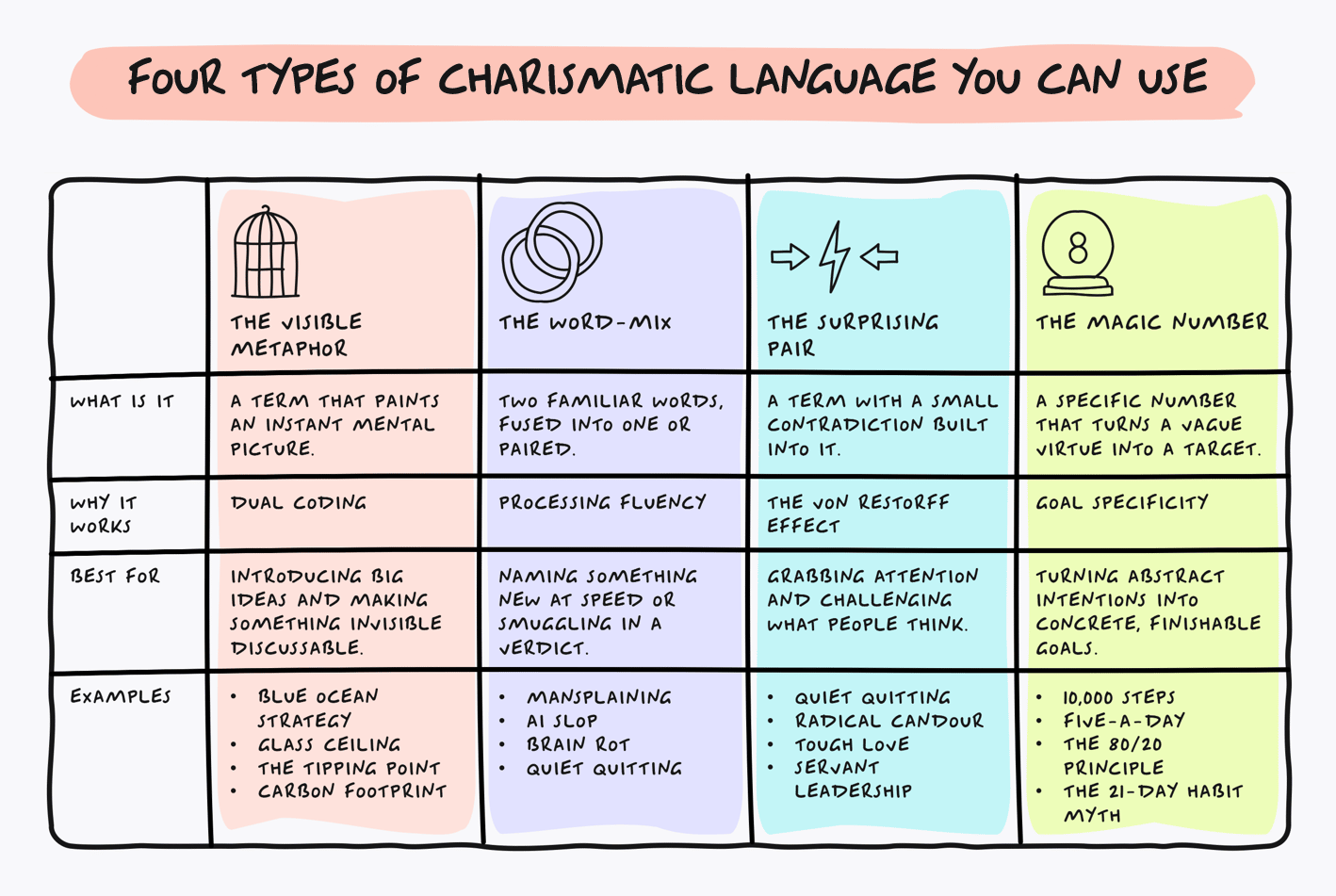
I've found four major types of charismatic language:
1. The visible metaphor
Our brains are wired to remember concrete images over abstract ideas. Psychologists call this dual coding, because a visual term gets stored as both a picture and a phrase.2 A lot of charismatic language capitalises on this quirk in human memory.
Best for: Introducing big ideas and making something invisible discussable.
Examples: The tipping point, the helicopter parent, the glass ceiling, carbon footprint, blue ocean strategy, the black swan.
2. The word-mix
We trust and like what our brains can process easily, a phenomenon known as processing fluency.3
Word-mixes exploit this by building new terms from words you already know, so the meaning arrives pre-explained. They might be two words merged into one, or simply put next to each other.
Best for: Naming something new at speed and for smuggling in a verdict.
Examples: Mansplaining, Brexit, hangry, podcast, brunch, humblebrag, AI slop, brain rot, doomscrolling, deep work, gig economy, Movember.
3. The surprising pair
Things that break an expected pattern get remembered better than things that fit it, known as the von Restorff effect.4
So some terms stick because they build a small contradiction into themselves. That tiny wrongness is what gets these terms remembered.
Best for: Grabbing attention and challenging what people already think.
Examples: Quiet quitting, radical candour, creative destruction, tough love, servant leadership, predictably irrational, antifragile.
4. The magic number
Decades of goal-setting research show that specific targets change behaviour far more reliably than vague encouragement.5 A number turns a fuzzy virtue into a finishable action: 'eat more fruit and vegetables' has no ending, but five-a-day tells you when you've won today.
Precision also smells like research, which is ironic, because the stickiest numbers have the worst accuracy record of the lot.
Best for: Getting people to turn abstract intentions into concrete goals.
Examples: 10,000 steps, 10,000 hours, five-a-day, the two-minute rule, the 80/20 principle, the 21-day habit myth, the four-hour workweek, Dunbar's 150, Couch to 5K.
How to create charismatic language
Here's the process I might suggest:
1. Start with the job, not the word.
Contexts where you might find this useful include naming:
- Events or rituals
- Goals and targets
- Desired norms
- Roles you need
- Customer experience
- Behaviours or competencies
Then ask yourself what you actually want the name to achieve.
Do you need people to see something they can't currently discuss? Or do something differently?
It may be both, like 'designated driver' was.
2. Draft through the four types.
Take your thing and see which of the four types of charismatic language might provide the best fit:
- Can you picture it? (the visible metaphor)
- Can you build it from two words people already know? (the word-mix)
- Can you create something with a small contradiction? (the surprising pair)
- Can you put a specific number or date with it? (the magic number)
Most attempts will produce something clunky, but AI is superb at rapid idea generation and you only need one winner.
Also, sometimes, you don't have to invent anything.
'Designated driver' had been a well-known concept in Scandinavia for over 50 years before Harvard sought to popularise this idea in the US.
Similarly, borrowing Amazon's 'two-pizza rule' might work just as well as creating your own charismatic language.
If you do try to create your own, a few further ways to increase stickiness include:
- Using alliteration
(e.g., quiet quitting, designated driver, Sunday scaries) - Prioritising brevity
(e.g., slop, nudge, grit, Brexit, brunch) - Making sure it's easy to pronounce
(e.g., brain rot, hangry, ghosting) - Avoiding clichés
(e.g., raising the bar, think like the CEO)
3. Test it, and see what sticks.
Run the guess test first.
Say your thing to a colleague with zero explanation, and check they can roughly guess what it means. See if they say it back to you a week later, unprompted.
And when one seems to stick, go big on it.
Use it in the meeting, in the calendar invite, in your casual conversations, in emails. Charismatic language spreads by repetition.
Obviously, this takes a little more effort than just calling your new process the 'System Q4 upgrade'.
But it's things like this that will give you The Illogical Edge.
Matt
P.S. Forward this on to a pal who needs to influence. They can get The Illogical Edge here.

Notes
[1] Winsten, J. A. (1994). Promoting designated drivers: The Harvard Alcohol Project. American Journal of Preventive Medicine, 10(3,), 11–14.
[2] Paivio, A. (1986). Mental representations: A dual coding approach. Oxford University Press.
[3] Alter, A. L., & Oppenheimer, D. M. (2009). Uniting the tribes of fluency to form a metacognitive nation. Personality and Social Psychology Review, 13(3), 219–235.
[4] von Restorff, H. (1933). Über die Wirkung von Bereichsbildungen im Spurenfeld [On the effects of field formation in the trace field]. Psychologische Forschung, 18, 299–342.
[5] Locke, E. A., & Latham, G. P. (2002). Building a practically useful theory of goal setting and task motivation: A 35-year odyssey. American Psychologist, 57(9), 705–717.