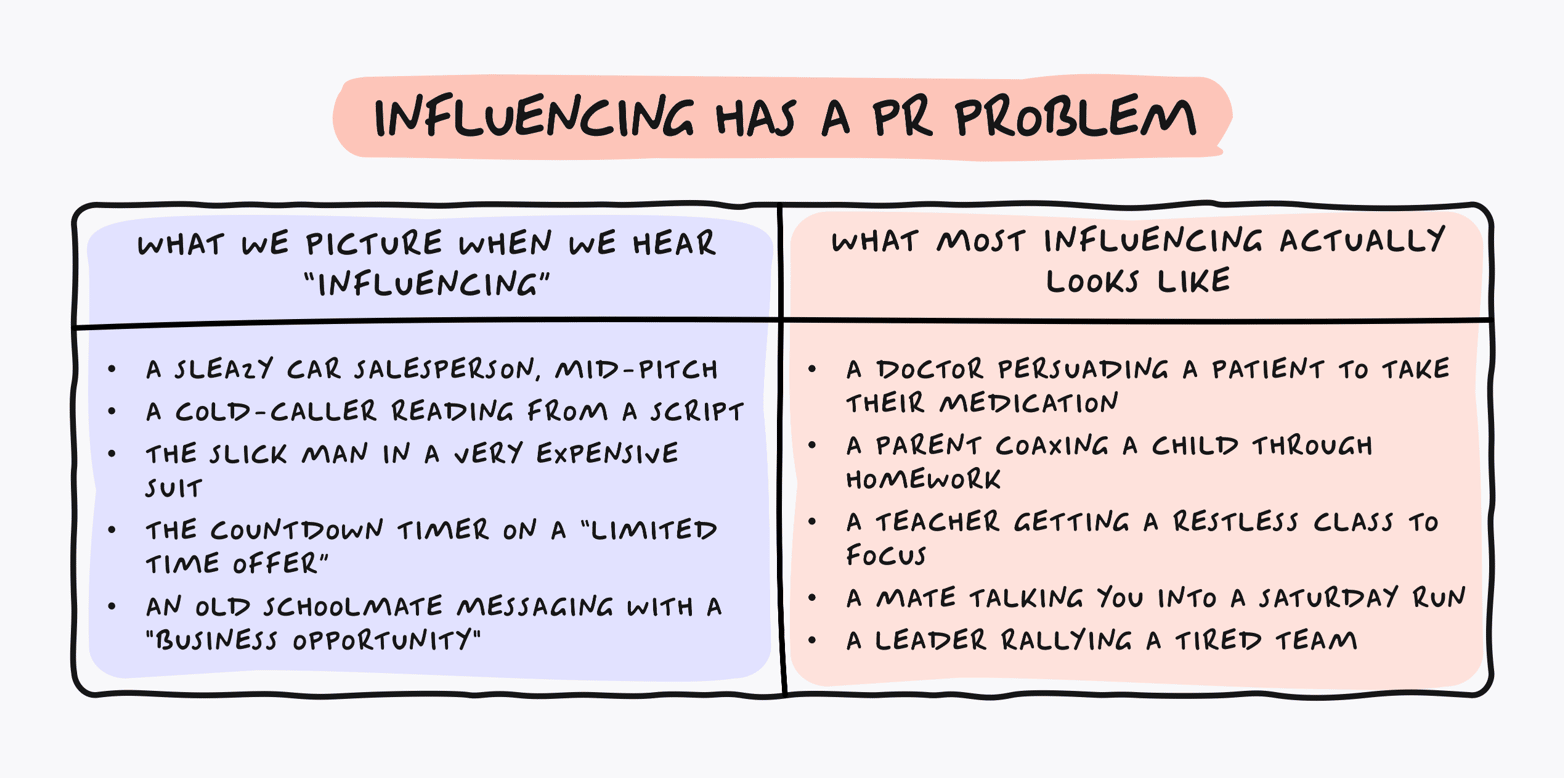
Nudges were, for a hot minute, the best thing on the planet.
They were introduced as a cheap way to influence behaviour at scale.
These days, though, I see two camps.
The first camp points to the:
- Nobel Prize
- Government units
- Successful case studies
The critics point the other way, to shaky replications and the effects that shrink to almost nothing once you look closely.1
Both camps have evidence, so who is right?
Both sides are arguing about the wrong thing
Neither, I would argue.
Both are answering the same question from opposite sides, but it is the wrong question.
They're asking whether nudges, as a category, work. As if a broad category of many techniques could be good or bad at behaviour change. As if a default or a reminder or a bit of social proof were either a reliable tool or a dud, settled once and for all.
But no behaviour change tactic is inherently good or bad.
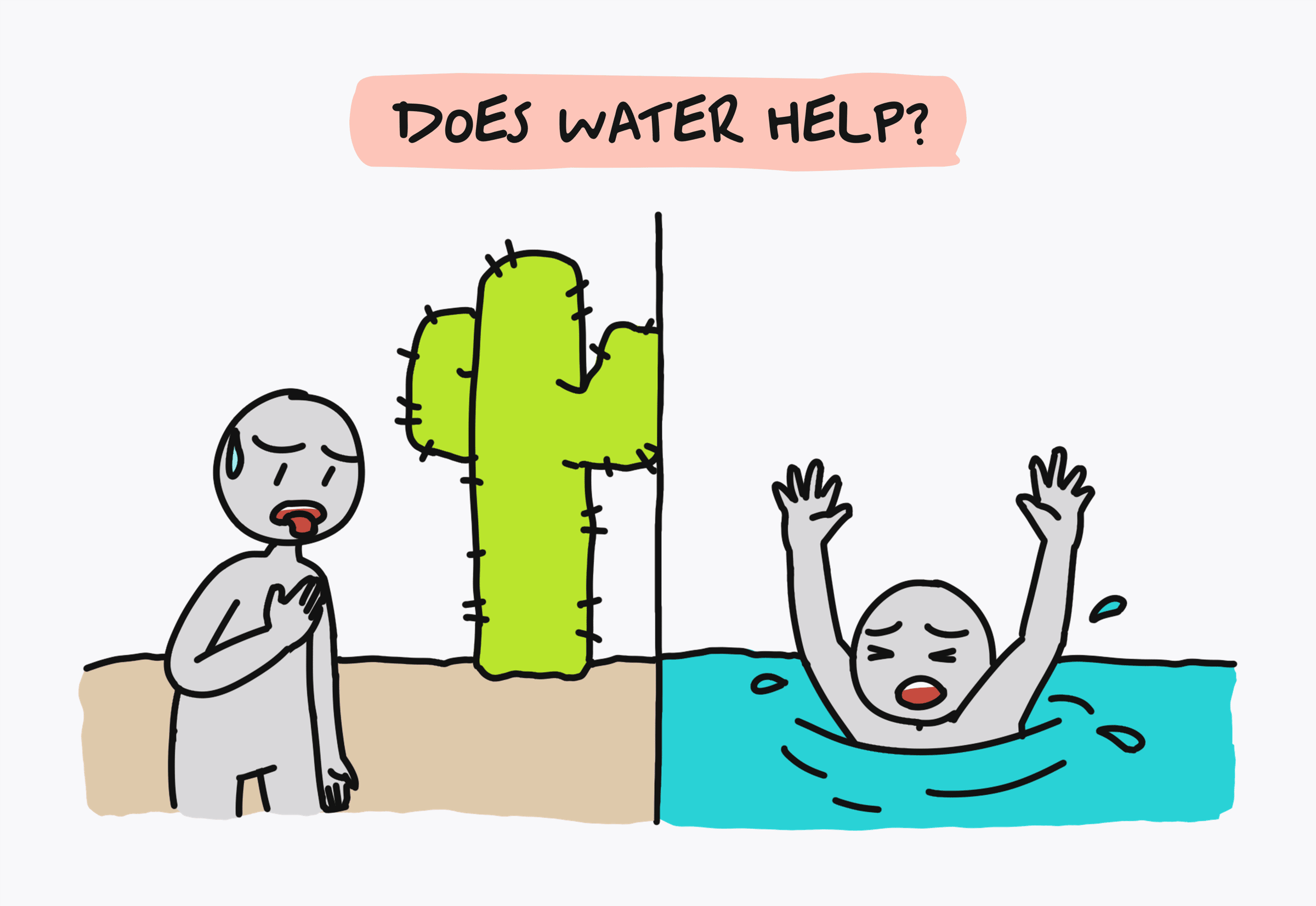
Asking "do nudges work?" is a bit like asking "does water help?" It rather depends on whether you're thirsty or drowning.
I think we just yearn, as humans, for a tidy tier list of behaviour change techniques. Defaults at the top, reminders in the middle, whatever has gone out of fashion at the bottom.
Man, that would make life simple.
Pick the ‘best-practice’ tactic and, hey presto, habits shift.
But unfortunately, the real world has little regard for what we want.
Sometimes the opposite of best practice wins
The clearest way to see this is to watch best practice fail on its own turf.
Take social proof.
Many cite Robert Cialdini's research here: never draw attention to the wrong behaviour when it is common, because you just advertise it as the norm. If you tell your team "lots of people haven't completed the questionnaire", you signal that not completing it is a pretty normal thing to do.2
Then, there’s Wikipedia.
You'll notice they do the opposite to what 'best practice' says you should do. They tell you something like, 'Less than 1% of people donate to Wikipedia. Will you?'
So why do they go against 'best practice'?
Well, researchers ran fundraising trials on its banners. Plain social proof, telling readers how many people had already given, did nothing. But framing the very same numbers in the negative, "only 400,000 people have donated" rather than "400,000 people have already donated", increased giving in this context. It seems when donating looks rare, your bit suddenly feels like it matters.3
As we can see, the “best-practice” move is sometimes the wrong one.
The Universalism vs. Cartography Schools
There are, I think, two ways of looking at behaviour change.
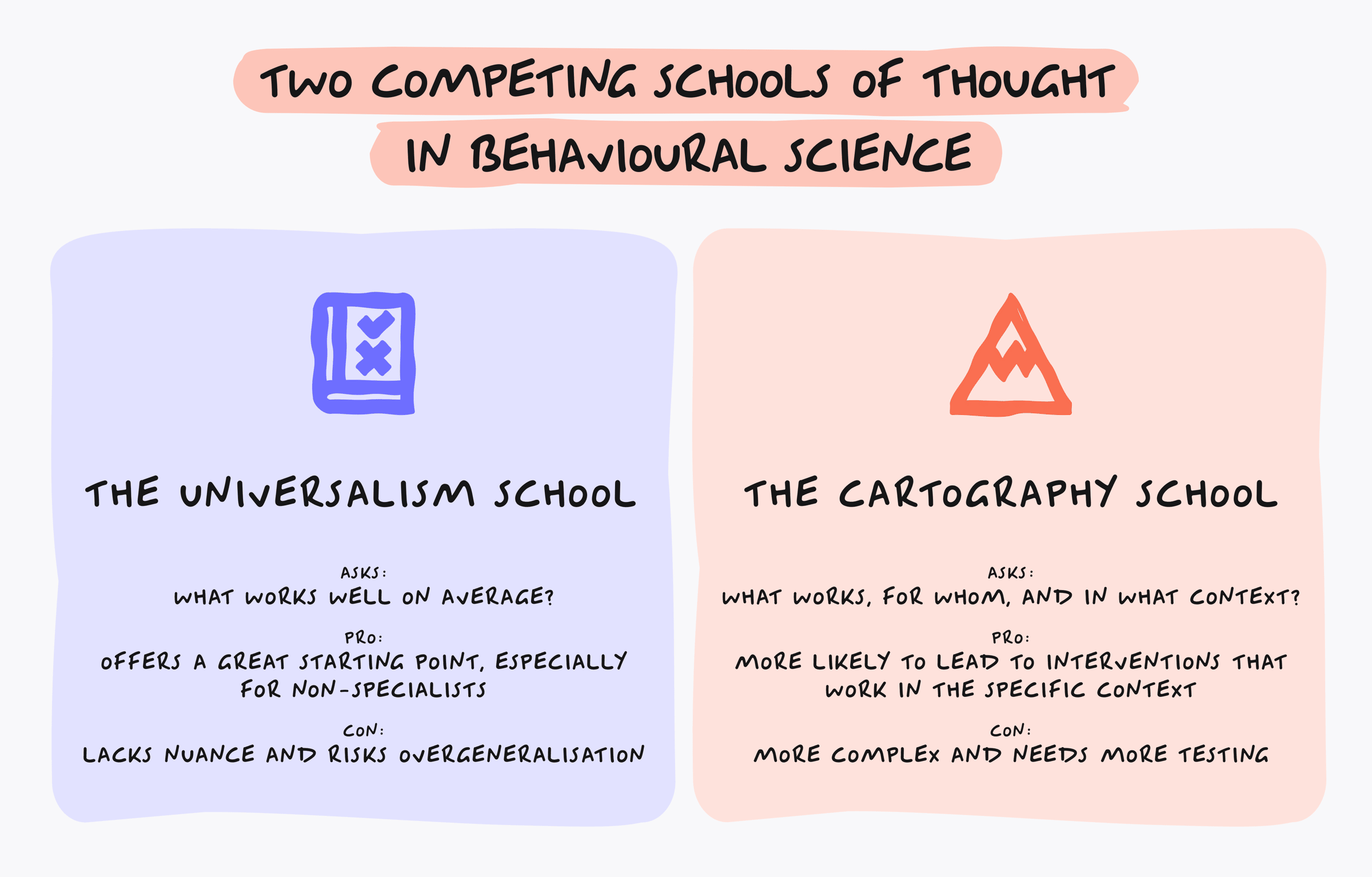
On one side is what I call the Universalism School.
It asks:
"What works on average?"
It leans on big reviews and meta-analyses to rank behaviour change tactics, and assumes some are simply more powerful than others. It's a fine place to start, especially if you're new to this.
On the other side is the Cartography School.
I got the name for this school from Dilip Soman, who argues behavioural scientists should think less like statisticians chasing an average and more like cartographers (people who create maps for a living).4
A cartographer sees little point in the average elevation of a country.
Canada's average height is around 500 metres, a number that is true and completely useless whether you're standing on a beach or halfway up a mountain. What matters is the terrain in front of you.
For the Cartography School, the same is true for behaviour change.
So they don’t ask, "What works on average?"
They ask, "What works, for whom, in what context?"
This isn't a fringe view.
Many of the field's leading researchers now argue that chasing average effects is exactly why so much behavioural science falls over when it meets the real world.5
But one might argue cartography could bring its own problems. At an extreme, it could ignore the genuinely useful behavioural science that likely works much of the time. It is also harder from a practical perspective as it requires more testing and nuance.
So what should we do in practice?
Best practice is a guide, not a bible
The truth, I think, sits in the messy middle.
Best practice is genuinely useful. A good review of the evidence across different contexts gives us a sensible first guess at what might work in your world.
You just can't treat it as gospel.
In practice, you can walk through five steps:
- Name the destination.
What behaviour are you trying to change, and why? - Read the ground.
Who are your people, and what is the context around them? - Grab the standard map.
What does best practice say to do here (make it easier, add social proof, send a reminder)? - Watch for cliffs.
What is different about your terrain, and where might that best-practice move backfire? - Walk a short stretch first.
What is the smallest test before you commit?
For example, say you have a sign-up page.
You want more people to choose your annual plan over the monthly one; the textbook says make the good option the default and opt people in automatically.
But before you do, you consider that in a low-trust setting, a default can feel like something's being done to people, and the moment they notice, they push back.
So perhaps you test both first, before going live.
You track sign up rates and perhaps speak to a few customers too.
Basically, you borrow the rule as a hypothesis, then let the terrain tell you whether you were right.
Best practice is a fine place to start. I'd just be wary of mistaking it for the finish.
Cartographically yours,
Matt
P.S. Forward this on to a pal who needs to influence. They can get The Illogical Edge here.

Notes
[1] Maier, M., Bartoš, F., Stanley, T. D., Shanks, D. R., Harris, A. J. L., & Wagenmakers, E.-J. (2022). No evidence for nudging after adjusting for publication bias. Proceedings of the National Academy of Sciences, 119(31), e2200300119.
[2] Cialdini, R. B., Demaine, L. J., Sagarin, B. J., Barrett, D. W., Rhoads, K., & Winter, P. L. (2006). Managing social norms for persuasive impact. Social Influence, 1(1), 3–15.
[3] Linek, M., & Traxler, C. (2021). Framing and social information nudges at Wikipedia. Journal of Economic Behavior & Organization, 188, 1269–1279.
[4] Soman, D. (2025, October 26). The behavioral scientist as a cartographer. Behavioral Scientist.
[5] Bryan, C. J., Tipton, E., & Yeager, D. S. (2021). Behavioural science is unlikely to change the world without a heterogeneity revolution. Nature Human Behaviour, 5(8), 980–989.