

Want to wind up a behavioural scientist?
Show them a “behaviour” like “caring about customers” and they’ll twitch.
The same is true for “behaviours” like:
- “Being accountable”
- “Having a growth mindset”
- “Creating psychological safety”
None of these, your behavioural scientist would point out, are really behaviours.
But a fair question might be whether they are just splitting hairs. Does it really matter what you call something, if everyone roughly knows what you mean?
If you want to create change, I’d argue it matters enormously.
What even is a behaviour?
In short, a behaviour is something a person says or does.
These are behaviours:
- “Ask one question in the team meeting”
- “Reply to a customer email within an hour”
- “Put the guard back on the machine before walking away”
All are actions that you can see with your own eyes or hear with your own ears.
Contrast that with, “caring about a customer”.
What you actually see or hear might be a handful of specific actions, like:
- Waiving the late fee.
- Remembering their name.
- Ringing back when promised.
“Caring” is the word you lay on top. It’s a bundle of behaviours, plus your judgement that they add up to something warm.
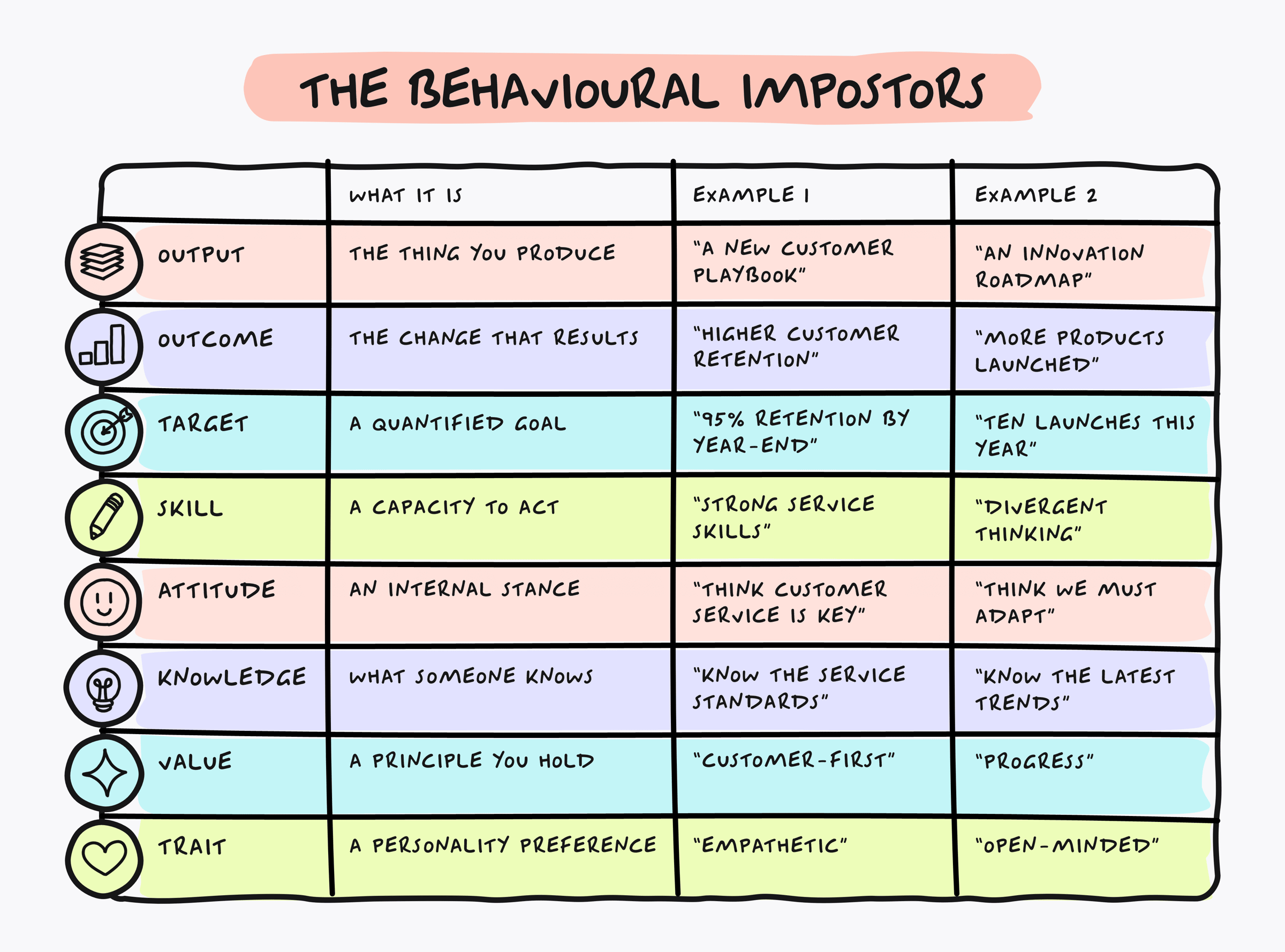
This is an example of what I call a Behavioural Imposter. It is basically something that people and businesses often call a behaviour, but it actually describes something else.
These imposters fall into two broad camps:
- Things inside someone’s head: skills, attitudes, feelings and knowledge.
- Things out in the world: outputs, outcomes and targets we chase.
Why does this even matter?
Well, let’s think about why we talk about behaviour at all.
It’s usually because we want something to change. We want someone to act differently, or we want to achieve a particular result.
Let’s imagine we want psychological safety at work.
Imagine we take aim at what’s inside people’s heads.
We run a workshop on why psychological safety matters. We tell managers to value openness and to believe in its importance.
It might land intellectually. But knowing and believing have a stubborn habit of not turning into doing.1 A manager can fully buy into psychological safety and still, in the moment, shut someone down for bringing bad news.
You can end up with people who know better, perhaps even want to change, but don’t do better.
Now imagine we aim at the outcomes.
Businesses do this constantly. They say they want a “psychologically safe culture”, so they put it on a slide and measure it on the annual engagement survey.
But that’s the scoreboard, not the game.
A psychologically safe culture is built through what people actually do. It's the consequence when someone admits a mistake without being publicly humiliated and when a manager welcomes an uncomfortable question.
Which leaves the behaviour.
It is, I’d argue, the most useful target we have.
Because once we’ve identified the specific actions we want, we can:
- Study why they’re not already happening
- Figure out the best ways to shift these behaviours
- Test what shifts them over time through measurement
So no, it isn’t splitting hairs.
Aim anywhere but the behaviour and you are either hoping a mental state converts, or wishing an outcome into being.
What stops us targeting behaviour?
So if behaviour gives us something concrete to work with, why do we keep grabbing at everything else?
A few reasons seem likely.
1. It’s genuinely hard.
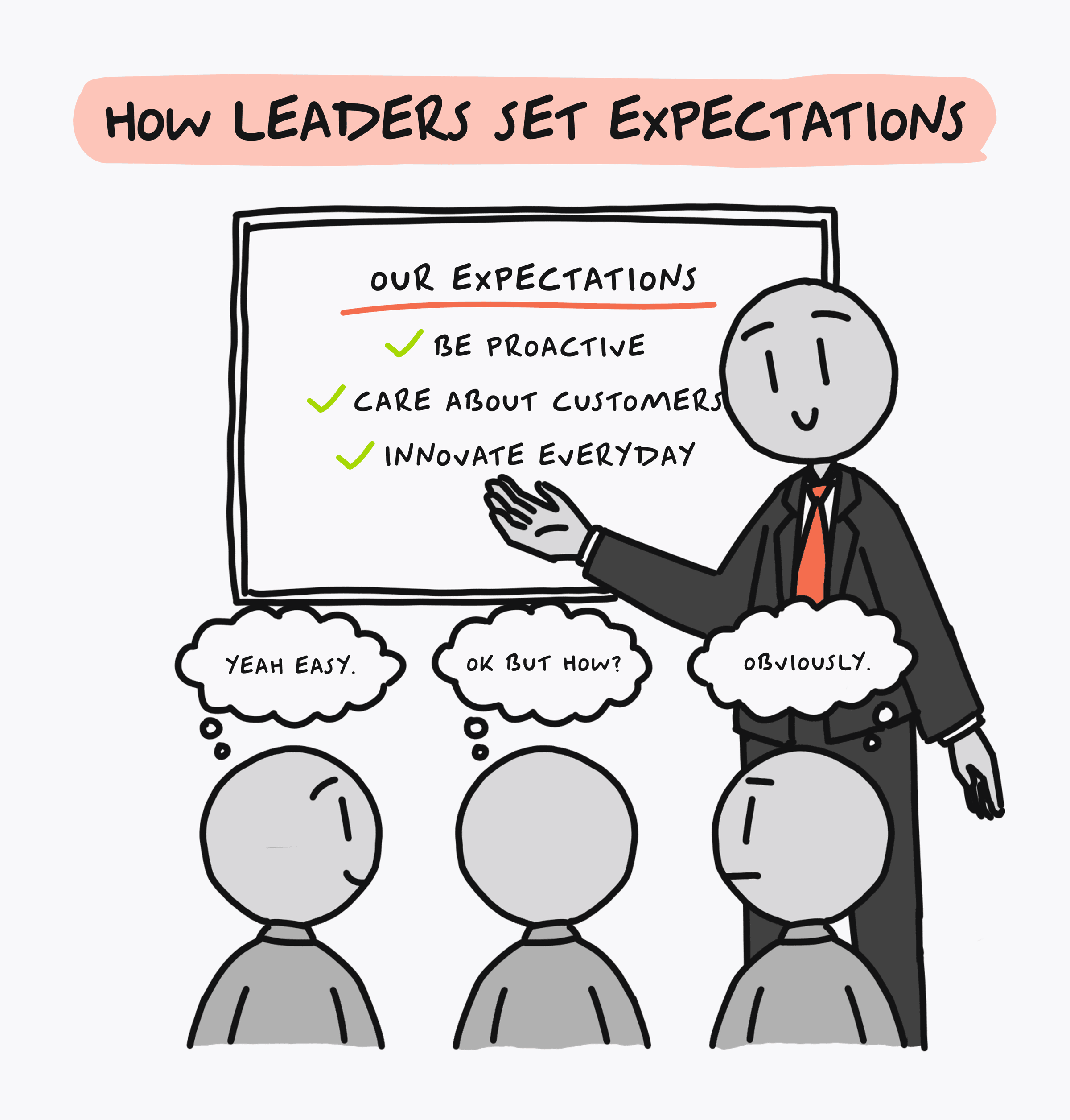
We know good behaviour when we see it, but we struggle to put it into words. Writing down an aspiration like “be more accountable” is easy. Working out precisely what accountability should look like in practice takes considerably more thought.
2. We assume it’s obvious.
We can picture what “good” looks like in our own heads, so we assume everyone else can too, and never bother to spell it out. Unfortunately, our picture may bear little resemblance to theirs.
3. The grand version sounds better.
“Build a culture of innovation” feels visionary. “Submit one idea at each monthly review” feels small, and a little naff. Nobody wants that on a strategy slide.
4. Vagueness is a hiding place.
If something can’t really be measured, you can’t be held to account against it. “Improve collaboration” protects you. “Post your blockers in the channel each morning” leaves you nowhere to hide.
In short, I’d argue the fuzzy option is the easy and comfortable one.
How to pinpoint a behaviour
So how can we turn Behavioural Imposters into actual behaviours?
One well-known technique is The Camera Test, which asks:
“If you filmed this person doing what you wanted, what exactly would you see or hear?”
Would you see them completing a particular action? Might you hear them saying something specific? If the camera couldn't capture it, you probably haven't defined an observable behaviour yet.
Then make it as specific as possible.
The sharper the behaviour, the easier it is to notice, to diagnose when it’s missing, to change, and to measure over time.
Take “give feedback” as an example.
Sure, it’s a behaviour, but ask two managers to do it and they might do completely different things.
Sharpen it by asking:
• Who, exactly?
• Does what, exactly?
• When, and how often?
• Where, or in what situation?
“Give feedback” might then become “Each manager gives every direct report one specific piece of feedback during their weekly one-to-one.”
Precise behaviours might be less inspiring on a poster.
But they're considerably more useful when you actually want something to change.
Precisely yours,
Matt
P.S. Forward this on to a pal who needs to influence. They can get The Illogical Edge here.

Notes
[1] Sheeran, P., & Webb, T. L. (2016). The intention–behaviour gap. Social and Personality Psychology Compass, 10(9), 503–518.