

Spare a thought for the corn salesmen of 1930s Iowa.
They had a seed that promised sturdier plants and bigger harvests, and they told farmer after farmer about it. Yet for years, most farmers carried on planting the old stuff.
The reason reveals something peculiar about how change spreads.
And today, I want to argue it holds a valuable lesson: the best way to change a whole organisation might be to begin by ignoring most of it.
Simple vs. complex contagions
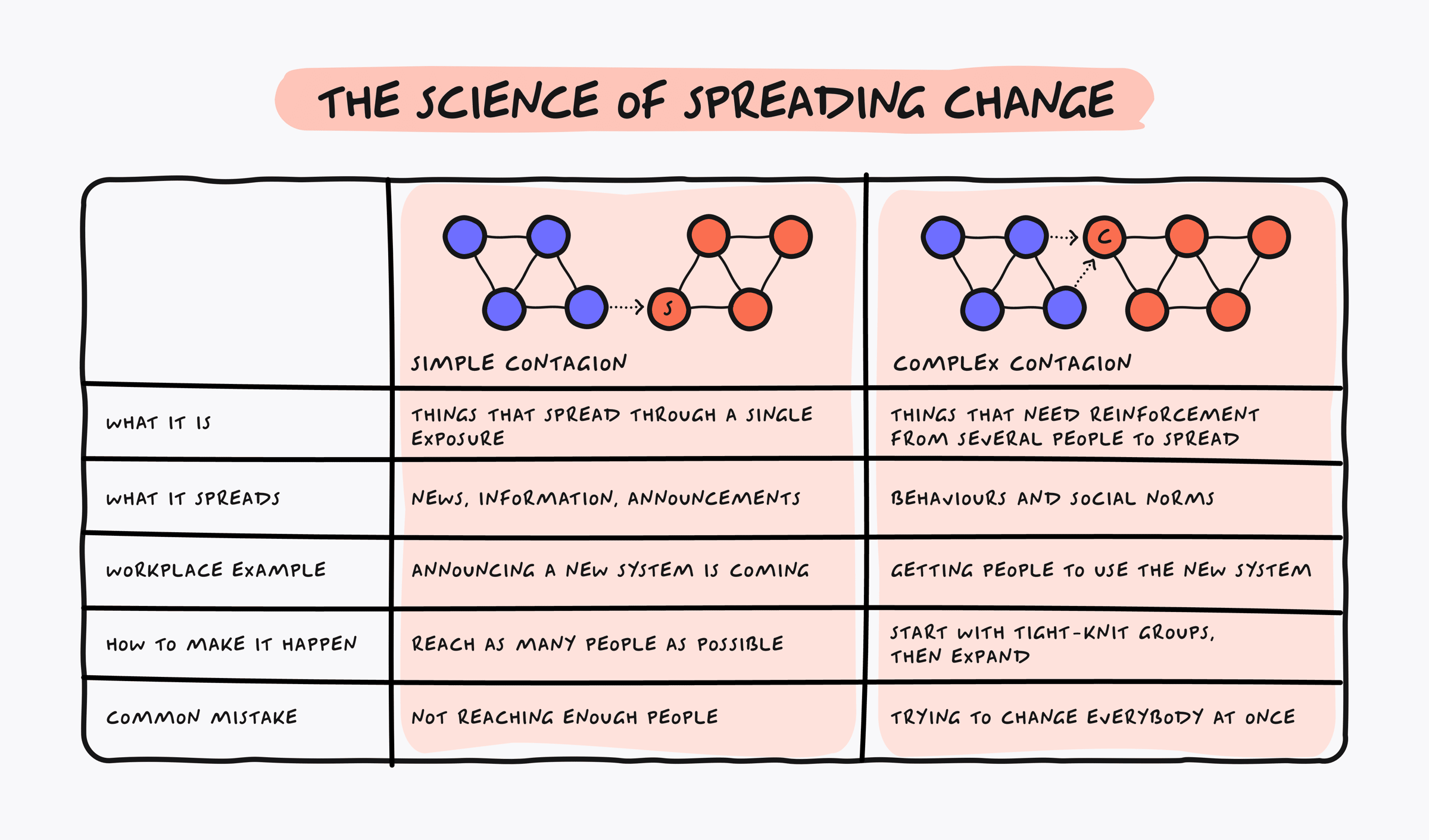
To understand what happened in Iowa, it helps to distinguish between two types of contagion, highlighted by the sociologists Damon Centola and Michael Macy.1
Simple contagions can spread through a single contact.
The common cold works this way, as does most information. You only need to hear about the restructure once to know it’s happening.
Then there are complex contagions.
This refers to things that only spread when there's reinforcement from several different people. When a change feels risky, or depends on other people doing it too, most of us want to see a few people go first.
Critically, this is how many behaviours spread.
Planting a new seed was a classic complex contagion problem because a farmer who backed the wrong crop risked a whole year’s harvest.
When sociologists Bryce Ryan and Neal Gross later studied two Iowa communities, they found that the salesmen were the most common source of initial information about hybrid corn. But when farmers were asked who had most influenced their decision to adopt it, they named their neighbours more often than anyone else.2
The early adopters had effectively become a testing ground for everyone else. Other farmers could see how the seeds performed before deciding whether to follow.
At work, we make the same mistake as the Iowa salesmen.
When we want to create mass change, we might:
- Send an all-staff email
- Host a company-wide event
- Launch a big internal comms campaign
The assumption is that maximum reach should bring maximum change.
The problem, though, is that many of the changes we care about rely on complex contagion. Things like adopting a new system, following a different process, changing ways of working, or using new technology.
Then we hit the same wall as the Iowa salesmen.
Take a new system.
Perhaps we launch it to everyone.
Two people in HR give it a go. Someone in Finance pokes around for ten minutes, then goes back to their spreadsheet. Each of them is surrounded by peers who haven’t changed, so nobody sees enough people doing it to feel safe.
So what’s the alternative?
The snowball strategy
If behaviours spread when people see several others like them doing it, reach alone is the wrong thing to chase. Reach everyone a little, and most people only see one or two colleagues try the new thing.
It’s rarely enough.
Which leads to a slightly odd conclusion.
If you want to start a movement, the smartest first move may be to ignore most people, at least to begin with.
Instead, you invest your limited time and effort on one tightly connected group until the behaviour feels normal there.
Only then do you help it spread more broadly.
The sociologist Damon Centola calls this the snowball strategy.3
There's experimental evidence that shows why this strategy works.4 In an online experiment with over 1,500 people, Centola found that 54% registered for a health forum when they were connected in tight clusters, compared with 38% when connections were spread more widely. Registrations also spread more than four times faster through the clustered networks.
Facebook's early growth followed a similar pattern.5
When it launched in February 2004, only people with a harvard.edu email address could join. So when new members joined, they found many of their classmates and friends already on the site.
Facebook then expanded to other universities, one by one.
Only once it had gained significant momentum did it open to anyone with a valid email address in September 2006.6
The catch is that much of the snowball strategy depends on that first group. If the behaviour doesn’t stick there, there’s nothing to roll outwards.
So where should you start?
Target first, scale second
Here are four criteria to look for when choosing your first group:
1. Tight-knit.
They already talk to each other most days. One team that shares regular meetings beats a dozen volunteers scattered across the business.
2. Likely to succeed.
The change might fix a problem they genuinely have. Leave the toughest groups until you have evidence to show and others have gone first.
3. Out of the spotlight.
Centola argues that change often gains a foothold at the edges of a network, where people face less pressure to stick with the status quo.3
4. Respected next door.
The teams around the group trust them and see them as ‘people like us’. They also have plenty of contact, giving the change somewhere to spread next.
The goal is to make that change stick in this small pocket first.
Then, you focus on scaling it.
You might pick the team that shares plenty of meetings and projects with your first group because overlapping relationships are invaluable in spreading the change. One colleague enthusing about a new way of working is easy to dismiss, but when several people you know and trust are doing it, it starts to feel like something worth trying yourself.
And once a few people in the next team adopt it, they can begin reinforcing each other, just as the first group did.
That's how your snowball grows.
Of course, there are still times for simple contagion, like if you must pass on knowledge about the change.
But if you need behaviour change, it’s worth asking this simple question first:
When someone considers trying this, how many people will they see doing it too?
If the answer is ‘not many’, your big bang may well create a lot of noise but very little change.
Yours by contagion,
Matt
P.S. Forward this on to a pal who needs to influence. They can get The Illogical Edge here.

Notes
[1] Centola, D., & Macy, M. (2007). Complex contagions and the weakness of long ties. American Journal of Sociology, 113(3), 702–734.
[2] Ryan, B., & Gross, N. C. (1943). The diffusion of hybrid seed corn in two Iowa communities. Rural Sociology, 8(1), 15–24.
[3] Centola, D. (2021). Change: How to make big things happen. Little, Brown Spark.
[4] Centola, D. (2010). The spread of behavior in an online social network experiment. Science, 329(5996), 1194–1197.
[5] Cohen, N. (2026, August 10). How Facebook escaped Harvard. Harvard Magazine. https://www.harvardmagazine.com/index.php/technology/harvard-facebook-history-mark-zuckerberg-winklevoss
[6] Facebook. (2006, September 26). Facebook expansion enables more people to connect with friends in a trusted environment [Press release]. https://about.fb.com/news/2006/09/facebook-expansion-enables-more-people-to-connect-with-friends-in-a-trusted-environment/
[7] First Round Review. (2015, February 26). From 0 to $1B - Slack’s founder shares their epic launch strategy. https://review.firstround.com/from-0-to-1B-slacks-founder-shares-their-epic-launch-strategy